

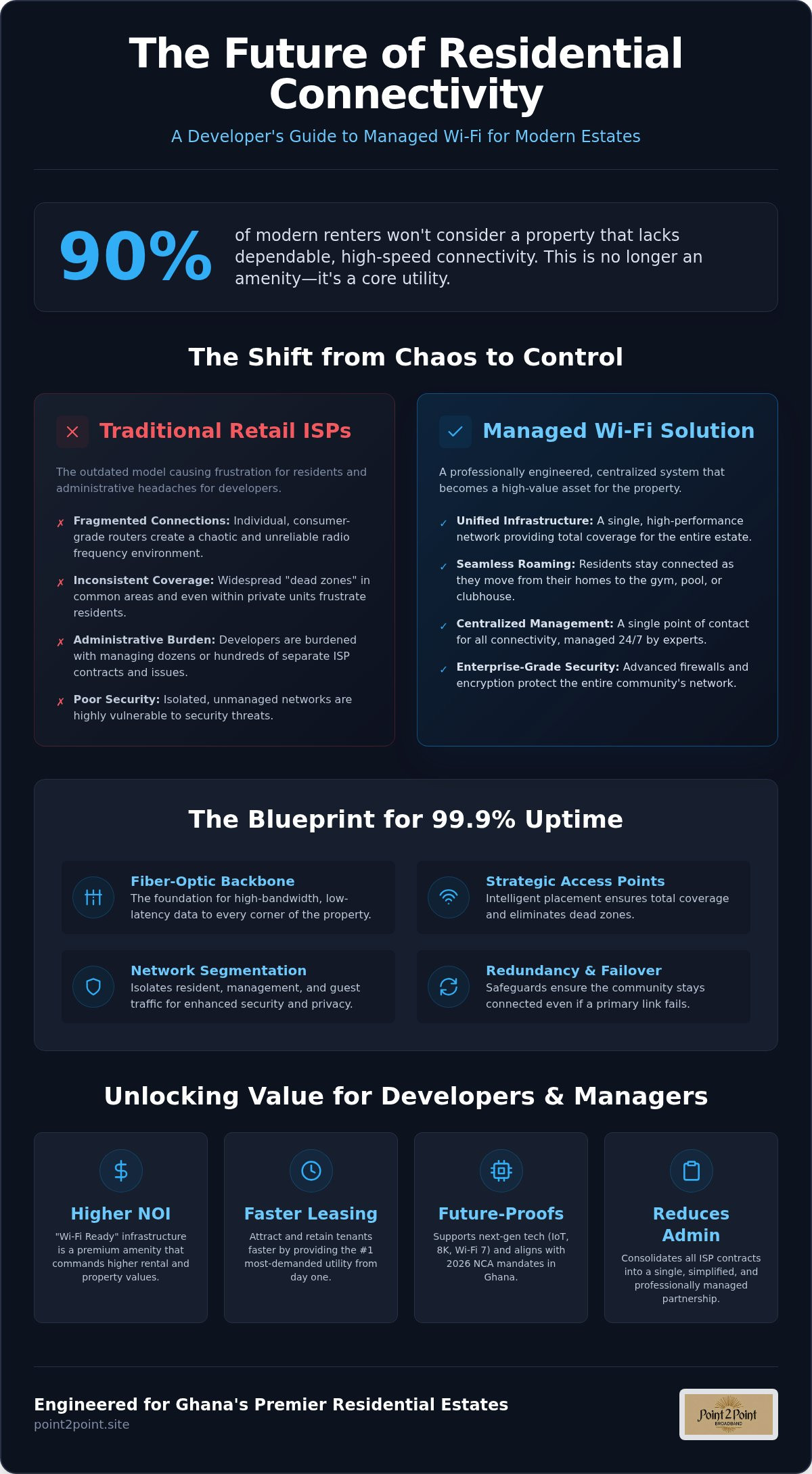
90% of modern renters won't consider a property that lacks dependable, high-speed connectivity. For developers and estate managers across Ghana, this reality creates a significant operational challenge. You've likely experienced the friction of inconsistent coverage in gated communities or the administrative burden of managing multiple ISP contracts for different buildings. These gaps in service don't just frustrate residents; they erode your property's long-term market value.
It's clear that connectivity is now a fundamental utility, requiring the same level of engineering precision as your electrical or water systems. This guide explores how professionally engineered managed wifi for residential estates transforms complex infrastructure into a high-value asset. You'll learn how to consolidate your network into a single, reliable partnership that supports Wi-Fi 7 standards and aligns with the 2026 NCA Quality of Service mandates. We'll examine the strategic shift toward scalable, community-wide systems that increase resident satisfaction and prepare your estate for the next generation of smart-home technology.
Key Takeaways
- Understand why traditional retail ISP models fail in complex developments and how managed wifi for residential estates offers a centralized, professionally engineered alternative.
- Identify the architectural requirements for high-performance connectivity, including the necessity of a fiber-optic backbone and strategic access point placement for total coverage.
- Learn how to leverage "Wi-Fi Ready" infrastructure to drive higher Net Operating Income (NOI) and shorten the leasing lifecycle for new residential projects.
- Navigate the five critical phases of the managed network lifecycle to ensure a seamless transition from initial design to long-term technical optimization.
- Gain insights into localized infrastructure strategies designed to meet the specific structural and regulatory demands of the Ghanaian real estate market.
Understanding Managed Wi-Fi in the Context of Residential Estates
In the modern Ghanaian real estate market, connectivity has transitioned from a lifestyle luxury to a non-negotiable core utility. High-end developments in leading residential markets now require the same level of engineering for their digital infrastructure as they do for plumbing and electricity. Managed wifi for residential estates represents a shift away from fragmented, consumer-grade setups toward a unified, professionally engineered network architecture. This system provides a centralized backbone that covers every square inch of a property, ensuring stability and performance that traditional retail models simply can't match.
While most developers understand the fundamentals of Wi-Fi technology, applying those principles to a sprawling gated community or a high-rise multi-dwelling unit (MDU) requires expert intervention. Traditional ISP models fail because they rely on individual, isolated connections. When each resident installs their own router, the result is a chaotic radio frequency environment that degrades the experience for everyone. Centralized control, by contrast, allows for intelligent frequency management and seamless roaming across the entire estate.
The transition to a managed model introduces several critical technical advantages:
- Centralized Management: Administrators monitor performance and resolve issues across the entire estate from a single professional dashboard.
- Seamless Roaming: Residents stay connected as they move from private units to common areas like gyms, clubhouses, or parks.
- Enterprise Security: Advanced encryption and firewalls protect the network at the perimeter, significantly reducing the vulnerabilities common in unmanaged consumer networks.
Managed Wi-Fi vs. Traditional Retail Broadband
Dense residential clusters often suffer from severe signal degradation due to overlapping wireless frequencies. When dozens of individual routers operate in close proximity, they create "noise" that slows down speeds and causes connection drops. Beyond technical performance, the administrative burden is significant for the developer. Managing a hundred separate ISP accounts creates a logistical nightmare that distracts from core estate management. Managed Wi-Fi is an end-to-end service that encompasses all hardware, cloud-based management software, and 24/7 technical support under a single service level agreement.
The Evolution of Smart Gated Communities
Modern estates increasingly rely on the Internet of Things (IoT) to provide security and operational efficiency. From smart perimeter fencing and automated gate access to energy-efficient street lighting, these systems require a backbone that won't fail under pressure. By 2026, the digital lifestyle has evolved to demand massive bandwidth for 8K streaming, virtual reality, and remote professional work. A managed network provides the scalability needed to support these future technologies without requiring a complete infrastructure overhaul. This visionary approach ensures that the estate remains competitive and technologically relevant for the long term.
The Architecture of High-Performance Estate Connectivity
High-performance connectivity isn't accidental. It's the result of intentional engineering and a commitment to structural integrity. In Ghana's premium residential sector, the foundation of every reliable network is a robust fiber-optic backbone. This physical infrastructure ensures that high-bandwidth data reaches every corner of the property without the latency issues common in legacy copper systems. When implementing managed wifi for residential estates, the network must be designed to handle simultaneous high-demand activities across hundreds of units without degradation.
A sophisticated architecture employs network segmentation to maintain performance and security. By isolating resident data from estate management systems and guest traffic, developers can guarantee privacy for tenants while protecting vital operations like CCTV and access control. Beyond the technical specs, there are clear Economic and Operational Benefits for Estate Developers who prioritize this level of infrastructure. To maintain 99.9% uptime, professional systems also include redundancy and failover protocols. These safeguards ensure that even if a primary link faces an outage, the community stays connected.
Professional Network Design and Engineering
A comprehensive site audit is the non-negotiable first step in professional network design. It identifies structural obstacles like reinforced concrete or metal roofing that impede signal strength. By mapping signal propagation, engineers eliminate "dead zones" in large estate topographies. For new developments, integrating tailored MDU solutions into the initial architectural blueprints prevents costly retrofitting later. This proactive approach ensures that managed wifi for residential estates is an invisible, seamless part of the living experience.
Hardware Standards: Wi-Fi 7 and Beyond
In 2026, Wi-Fi 7 has become the benchmark for high-density residential environments. It utilizes Multi-Link Operation (MLO) to significantly reduce latency and increase throughput for every resident. Enterprise-grade hardware is built for continuous, high-load operation, outlasting and outperforming consumer-level equipment. In luxury settings, this hardware must also be discreet. High-performance Access Points are now designed to blend into the ceiling or wall, maintaining the property's aesthetic integrity while delivering elite performance. This balance of form and function is what defines a truly modern, digitally-advanced community.
Economic and Operational Benefits for Estate Developers
Strategic infrastructure investment should yield measurable returns. In the context of large-scale residential developments, managed wifi for residential estates shifts connectivity from a traditional cost center to a robust revenue driver. By implementing a centralized network, developers can increase their Net Operating Income (NOI) through managed service models that offer residents superior performance at competitive rates. This approach eliminates the inefficiency of third-party retail ISPs while providing the estate with a predictable, long-term income stream.
"Wi-Fi Ready" infrastructure significantly accelerates the sales and leasing lifecycle. Research involving over 172,000 renters found that 87% consider dependable internet essential to be active immediately upon moving in. When a home is digitally provisioned before the tenant arrives, the friction of move-in day is removed. This immediate connectivity serves as a powerful closing tool for sales agents, reducing vacancy periods and ensuring that high-value properties reach full occupancy faster.
Operational overhead is often a hidden drain on estate resources. Managing dozens of individual resident complaints regarding connectivity takes time away from core property management tasks. Outsourcing these requirements to a specialized partner provides a "silent partner" experience where technical support and network maintenance are handled externally. This professional oversight ensures that the estate’s digital reputation remains untarnished by the inconsistent service levels typical of consumer-grade providers.
Data-driven insights empower managers to make informed decisions about future infrastructure needs. Professional network analytics provide a clear view of bandwidth consumption patterns and community usage trends. This information allows for precise resource allocation and helps developers identify which amenities, such as clubhouses or business centers, require additional capacity. These metrics turn anecdotal feedback into actionable engineering data.
Connectivity as a Premium Amenity
Managed Wi-Fi serves as a critical differentiator in Ghana's competitive luxury market. High-speed, estate-wide connectivity directly impacts property valuation by positioning the development as a sophisticated "Smart Community." This branding attracts high-value tenants who prioritize digital stability for remote work and entertainment. In a market where 90% of renters state they won't lease without dependable high-speed internet, premium connectivity is no longer optional; it's the foundation of resident retention.
Streamlining Estate Management Operations
A unified network simplifies the integration of essential estate services. Security cameras, access control systems, and smart utility meters can all operate on the same secure backbone, reducing the complexity of managing multiple vendors. For Homeowners' Associations (HOAs), this centralized approach reduces the administrative burden and ensures equitable bandwidth distribution across the entire cluster. This systematic design prevents "digital divides" within the community, ensuring every resident receives the same elite level of service regardless of their location within the estate.
The Managed Network Lifecycle: From Audit to 24/7 Support
A professional network isn't a static installation; it's a dynamic ecosystem that requires continuous oversight. To maintain the high standards expected in Ghana’s luxury sector, managed wifi for residential estates must follow a structured lifecycle. This systematic approach ensures that the infrastructure remains performant, secure, and capable of meeting the evolving digital demands of residents. By treating connectivity as a managed service rather than a one-time hardware purchase, developers protect their investment from premature obsolescence.
The lifecycle begins with a rigorous five-phase process: Audit, Design, Deploy, Manage, and Optimize. During the deployment of MDU broadband solutions, engineering teams prioritize minimal disruption. This is achieved through non-invasive installation techniques and the use of existing structural conduits. Once live, the network is transitioned to a Network Operations Center (NOC) for proactive monitoring. This center acts as the "brain" of the estate, detecting potential faults and resolving them before a resident even notices a drop in signal quality.
Performance is guaranteed through rigorous Service Level Agreements (SLAs). These contracts define the standards for uptime and speed, aligning with the 2026 National Communications Authority (NCA) mandates for quality of service. In an era where a single hour of downtime can lead to significant resident dissatisfaction, these guarantees provide the peace of mind that estate managers require. If you're ready to transition to a professionally managed infrastructure, you can request a technical consultation to begin your network audit.
Phase 1: The Professional Network Audit
Success starts with a deep technical analysis of the physical environment. Engineers identify structural bottlenecks, such as high-density concrete walls or signal interference from neighboring properties, that could compromise performance. This phase involves consulting with developers to align the network’s total capacity with projected resident growth over the next decade. A professional audit serves as the non-negotiable foundation for network scalability, ensuring that today's infrastructure doesn't become tomorrow's bottleneck.
Ongoing Management and Technical Support
High-end residential estates require a tier of support that goes beyond standard consumer helpdesks. 24/7 technical oversight is essential to maintain the elite resident experience. While many issues are resolved through remote troubleshooting and cloud-based adjustments, on-site engineering teams must be available for physical hardware maintenance when required. Beyond basic connectivity, the management phase includes the regular deployment of security patches and firmware updates. These proactive measures protect the entire community from emerging cyber threats, ensuring the network remains a secure environment for sensitive data and smart-home operations.
Point 2 Point: Elevating Residential Infrastructure in Ghana
Point 2 Point Broadband represents a departure from the "utility-only" mindset that often dominates the Ghanaian market. We approach every development as a unique engineering challenge, requiring a bespoke solution rather than a one-size-fits-all package. By specializing in managed wifi for residential estates, we've positioned ourselves as the technical authority for developers who refuse to compromise on quality. Our dual presence in West Africa and Europe allows us to import global best practices and apply them to the specific structural realities of the local landscape.
Luxury estates trust our team because we understand the nuances of high-end residential life. We recognize that connectivity isn't just about speed; it's about the stability that residents need for remote executive work and the security required to protect private data. Our commitment to engineering excellence ensures that every access point and fiber line is placed with precision. We don't just provide internet; we build the underlying systems that define a property's value in the 2026 digital economy. Working with a partner that understands National Communications Authority (NCA) standards ensures your estate remains compliant while delivering elite performance.
Engineered for Stability and Performance
Our methodology prioritizes structural integrity and systematic design. We recognize that West African architectural trends, such as heavy reinforced concrete and expansive gated layouts, require a different approach than standard international models. By integrating MDU solutions with professional network design, we ensure that your infrastructure delivers maximum ROI. This systematic approach applies enterprise-level organizational standards to the residential context, creating a network that's as durable as the buildings it serves. We focus on the long-term lifecycle of the system, ensuring that managed wifi for residential estates remains a high-performance asset for years after the initial deployment.
Your Visionary Partner in Connectivity
We see ourselves as your "silent partner" in property management. Our team handles the complex technical requirements of modern connectivity so you can focus on the broader vision of your development. Beyond providing high-speed access, we build the digital foundation necessary for smart, sustainable communities. This includes supporting the IoT systems and security protocols that modern luxury residents expect. We believe that a visionary developer deserves a visionary engineer.
The first step toward securing your property's digital future is a comprehensive technical assessment. Our engineering team is ready to analyze your estate's specific requirements and design a network that scales with your growth. Consult with Point 2 Point Broadband for your estate connectivity needs and discover how our engineered solutions can transform your development into a high-value, digitally-advanced community.
Securing the Digital Future of Your Estate
High-performance connectivity has evolved into the cornerstone of modern property valuation. By prioritizing professional network design and systematic infrastructure, you ensure your development meets the rigorous 2026 standards for reliability and security. This strategic shift to managed wifi for residential estates doesn't just resolve technical friction; it creates a scalable foundation for future smart-home technologies and long-term resident retention. You've seen how centralized management and engineered stability transform a property from a simple dwelling into a digitally-advanced community.
Point 2 Point serves as your visionary partner in this transition. We bring specialized expertise in professional network design for complex residential clusters and provide 24/7 proactive monitoring through our dedicated Network Operations Center. Our tailored MDU solutions are engineered to maximize developer ROI while delivering a seamless, enterprise-grade experience for every resident. It's time to move beyond fragmented retail models and embrace a unified, professionally managed infrastructure.
Partner with Point 2 Point for Premium Estate Wi-Fi and redefine the digital standard of your community. We're ready to help you build a more connected and valuable future.
Frequently Asked Questions
What is the difference between bulk internet and managed Wi-Fi for estates?
Bulk internet is a commercial arrangement where residents receive individual accounts at a discounted rate, while managed Wi-Fi is a unified, engineered network infrastructure. Bulk models often lead to signal interference because each unit has an isolated router. Managed wifi for residential estates provides a single, cohesive system with seamless roaming, ensuring residents stay connected as they move between their homes and common areas.
How does managed Wi-Fi increase the resale value of residential properties?
Managed connectivity increases property value by positioning the estate as a "Wi-Fi Ready" smart community, which is a top priority for 90% of modern renters. This infrastructure enhances Net Operating Income (NOI) and shortens the sales cycle for developers. In the luxury market, pre-installed, enterprise-grade internet is viewed as a fundamental utility that justifies premium pricing and attracts high-value investors.
Can a managed Wi-Fi system be installed in an existing residential estate?
Existing estates can be retrofitted through a professional "brownfield" deployment process. Engineers conduct a thorough audit to identify how to utilize existing structural conduits for new fiber-optic backbones. Professional installers use non-invasive techniques to upgrade the network, ensuring that the transition to modern connectivity standards happens with minimal disruption to current residents.
Is managed Wi-Fi more secure for residents than a traditional home router?
Managed networks offer significantly higher security than traditional home routers by utilizing enterprise-grade firewalls and centralized encryption protocols. While individual routers often have unpatched vulnerabilities, a managed system receives regular, automated firmware updates. Proactive monitoring at the network perimeter detects and mitigates cyber threats before they can impact the resident's private data or devices.
How does managed Wi-Fi handle high-bandwidth activities like gaming and 4K streaming?
These systems are designed for high-density usage by employing Wi-Fi 7 standards and dedicated fiber backbones. The architecture supports 320 MHz channels and advanced modulation to provide the throughput necessary for simultaneous 4K streaming across hundreds of units. Strategic engineering ensures low-latency performance for gaming, even during peak hours when community-wide demand is at its highest.
What happens if the main fiber line to the estate goes down?
Professional network designs include redundancy and failover systems to ensure 99.9% uptime. This often involves secondary wireless bridges or diverse fiber routing paths that automatically activate if the primary link fails. These safeguards are critical for maintaining the stability and peace of mind expected in high-end residential environments where constant connectivity is a requirement.
Who is responsible for providing technical support to the residents?
The managed service provider takes full responsibility for technical support through a dedicated Network Operations Center (NOC). This removes the administrative burden from estate managers and Homeowners' Associations. Residents receive direct access to specialized engineering expertise, while proactive monitoring often resolves potential issues before they result in a service disruption.
Can managed Wi-Fi support estate-wide security systems and IoT devices?
Managed wifi for residential estates is the ideal foundation for integrating IoT devices, CCTV, and automated access control systems. Through network segmentation, managers can isolate estate operations on a secure private network that doesn't interfere with resident traffic. This centralized approach ensures that all smart community features operate on a single, reliable backbone while maintaining strict data privacy for every household.